Branding: A clearly defined sense of purpose that goes beyond profit
Drawing on recently released findings from Industry Partners’ 2024 Accountancy Brand Survey, Sholto Lindsay-Smith examines the factors making a winning brand.

In the competitive world of professional services, brand reputation is a currency of its own. It is now widely recognised a powerful brand attracts clients, secures top talent, and inspires trust. Amongst the professions, the leading accounting firms have been at the forefront of brand building, investing millions to establish a brand advantage.
Survey methodology and findings
Our survey, the second in our professional services benchmark series, surveyed 302 respondents in the UK, split between:
- Graduates studying or aspiring to work in accountancy (34%),
- Clients selecting accounting services (32%), and
- Accounting professionals working in practice (34%).
Respondents were drawn from a paid research panel to ensure representation across firm sizes and career stages.
Brand matters
The findings underscore the critical importance of brand reputation in securing new business, with 84% of clients deeming it critical when considering which firm to appoint. Brand is also an essential consideration for prospective recruits, with 86% of graduates and 88% of accounting professionals saying brand reputation is extremely important when choosing a firm.
To underscore this, when asked what the single most important factor is when you are considering appointing an accounting firm, a staggering 29% of clients said brand reputation.
The top performing brands
The survey asked respondents to rank – unprompted – who they considered to be the top five accounting firm brands with the strongest brand reputation. This question is perhaps the toughest but most realistic assessment of brand performance as it takes into consideration both front of mind brand awareness as well as reputation.
The findings reveal the top-performing brands, including PwC, Deloitte, KPMG, and EY, dominate perceptions among clients and professionals alike. Interestingly KPMG, the smallest of the big four, scored highest with clients.
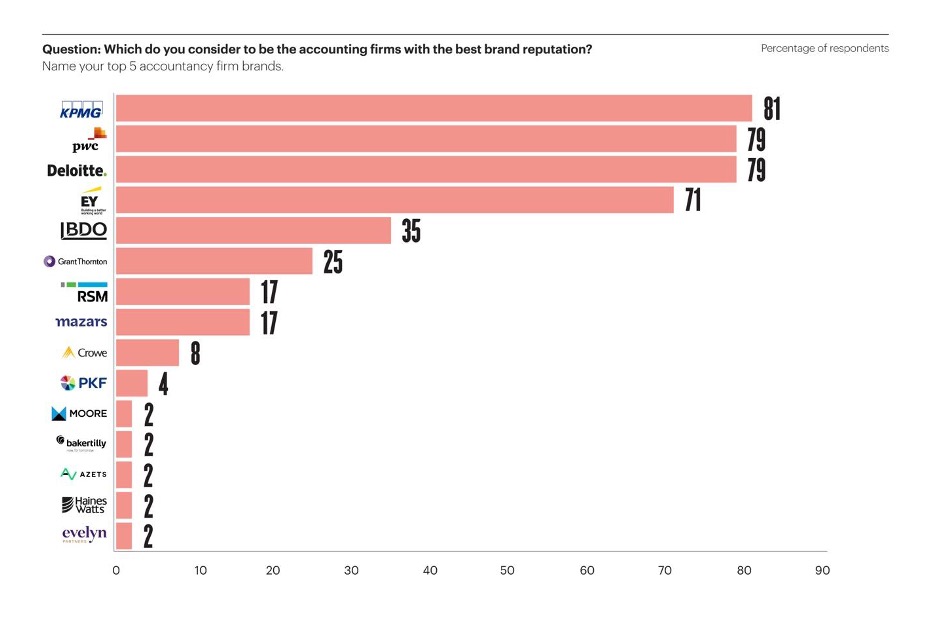
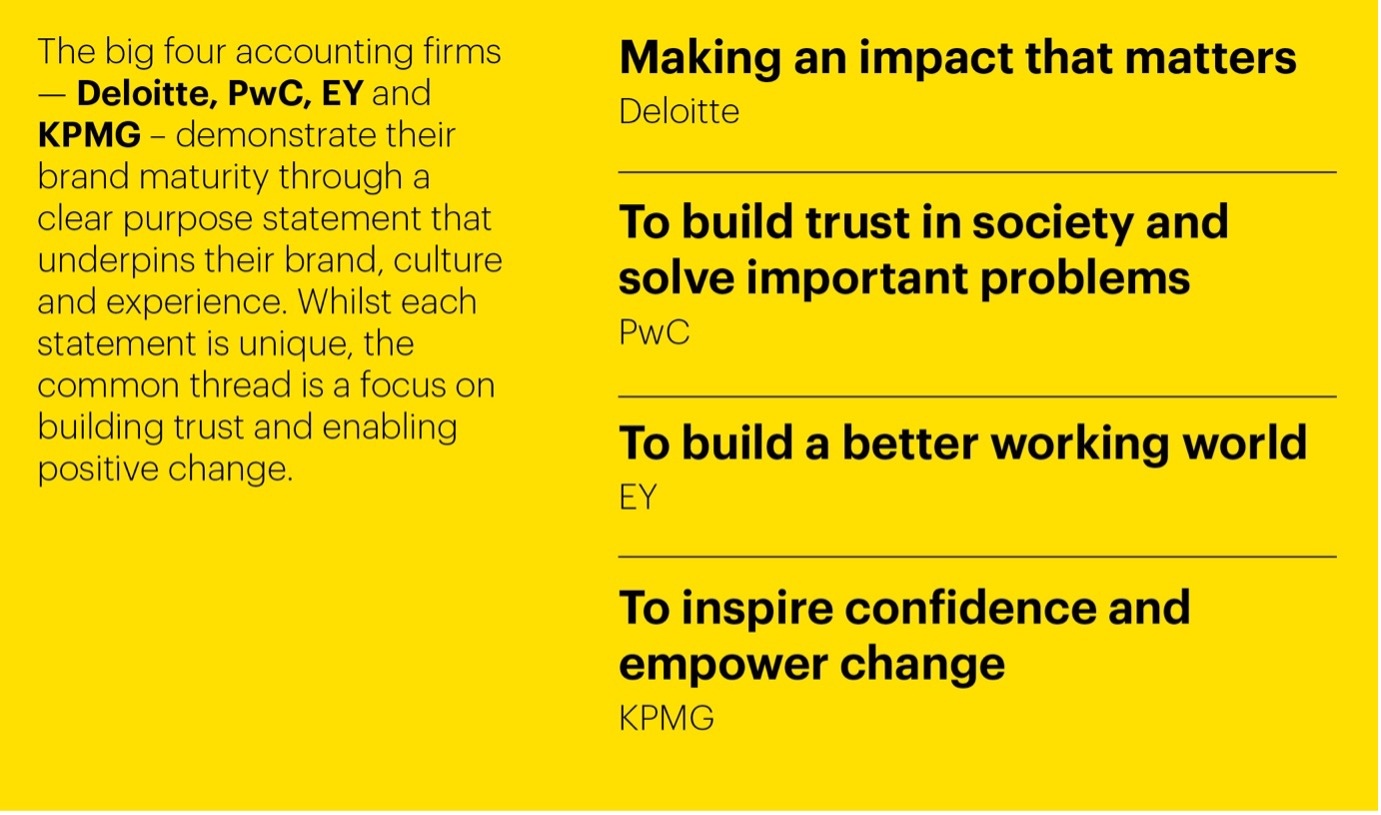
The big four’s scale means they have a clear advantage when it comes to brand awareness. Yet, their success stems from more than their size or technical prowess. These firms excel in ‘soft qualities’ and have aligned their brand, culture and experience on a global scale ensuring a strong client focus and consistency in service standards, underpinned by a huge investment in training of their people. Each of the big four also have a clearly defined sense of purpose goes beyond the profit motive.
“PwC’s position as the top choice employer – with 60% ranking it among their top three – reflects its success in building a strong employer brand. Interestingly PwC is the first of the big four to shift the working balance back towards more in-person working, citing the focus on ‘client service, coaching, and learning and development’ as a key driver behind the decision”
BDO leads the pack with RSM, Grant Thornton and Moore in pursuit. These international networks have recognised the importance of having a strong brand profile if they want to win work from the big four and are now well advanced in their journey to consolidate their global presence under a single brand. This particularly matters where PLCs need the imprimatur of a respected audit brand to give confidence to shareholders.
We can therefore anticipate we will see more brand consolidation amongst the remaining mid-tier networks as they follow suit. Brands like Saffery have already made this step by aligning their brand more closely with Nexia [the top 15 network of independent accounting and consulting firms], reflecting its increasing focus on the demand for cross-border advice and services from clients around the world.
The challenge of integration and assimilation of brands is not straightforward. It requires a huge investment to establish a new brand, especially when changing name. Our survey showed legacy brand names can persist into the future, even when they have been retired. For example, Smith & Williamson continued to be cited by respondents rather than using the new name of Evelyn Partners.
Client centricity is the key to success
Understanding and addressing client needs is paramount. Notably, 90% of respondents valued a firm’s ability to understand their business, while 88% emphasised strong customer service. Clients also rated speed of response and attitude of the accountants as key attributes. These are all qualities highlighting the importance of underpinning the brand promise with a highly responsive client centric culture.
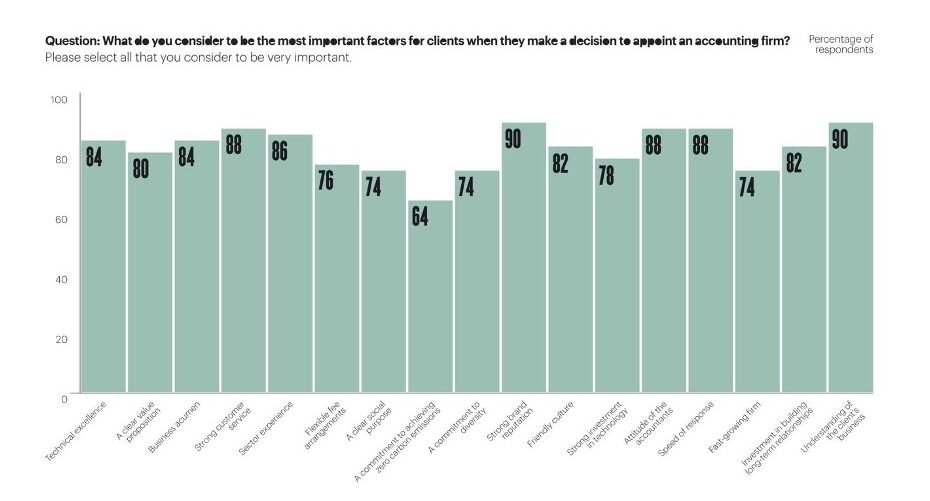
These insights point to firms investing in relationship-building over transaction-based engagements if they want to win the brand battle. Grant Thornton is on the money with their proposition:
“We go beyond business as usual, so you can too. We make business more personal by investing in building relationships. …We work at a pace that matters – yours.”
Culture lies at the heart of an attractive employer brand
Brand strength also influences talent acquisition and retention, and the culture of the firm is central to this, especially for the next generation.
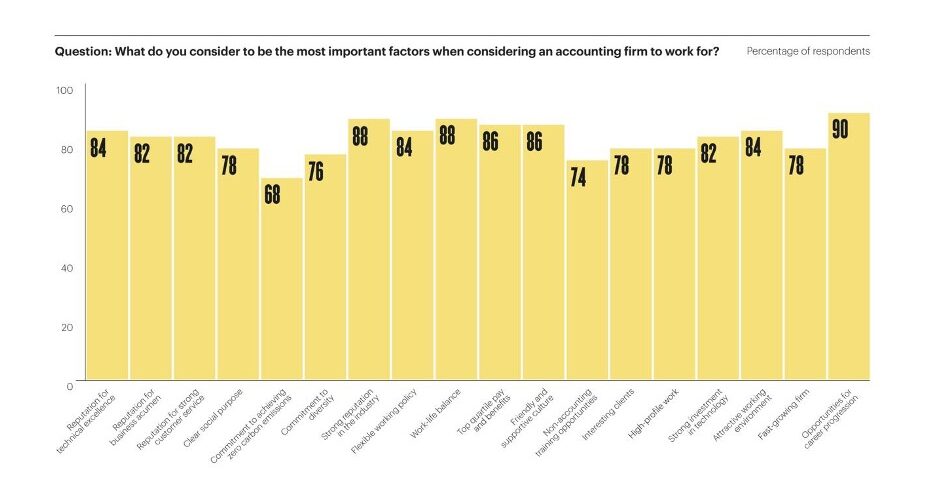
When asked the open-ended question, “What would you consider the single most important factor when considering a firm to work for?”, 65% of young professionals highlighted company culture and work environment compared to 29% of experienced accountants. In keeping with the findings from our legal benchmark survey, these findings suggest the next generation of professionals are as concerned with quality of life as they are with pay and promotion.
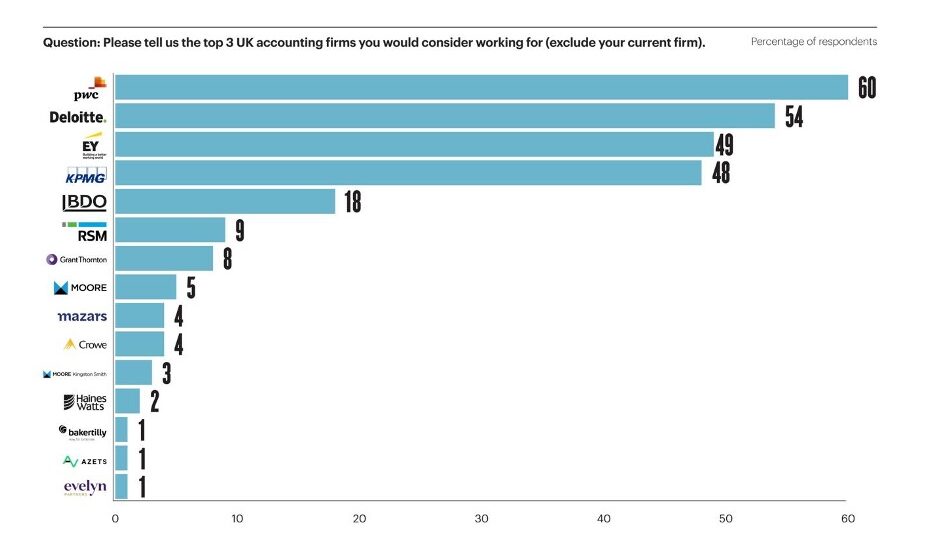
PwC’s position as the top choice employer—with 60% ranking it among their top three – reflects its success in building a strong employer brand. Interestingly PwC is the first of the big four to shift the working balance back towards more in-person working, citing the focus on ‘client service, coaching, and learning and development’ as a key driver behind the decision.
This mirrors the actions of many big corporates who have argued being in the office is better for building an engaging work culture, encouraging innovation, fostering client relationships as well as providing better learning opportunities for the next generation. It is a fair bet the physical work environment will once again become a key pillar of building a strong employer brand.
Building a brand advantage
To thrive in this evolving landscape, accounting firms must balance traditional strengths with modern expectations. For small and mid-tier firms, the core challenge is building brand awareness.
Outside the big four, fortune will favour the challenger brands who are bold enough to invest in building brand awareness beyond their size. For larger firms, sustaining their lead will require agility in adapting to generational shifts and societal expectations.
Ultimately, a winning accounting brand is not just about being known but about being centred on serving the client. The best-performing brands will be those successfully combining expertise with empathy.